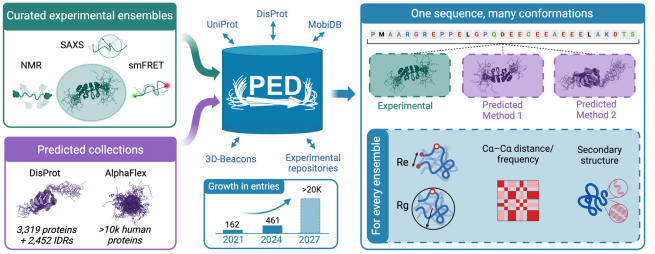
The latest release of the Protein Ensemble Database (PED) is presented in a new paper published in Nucleic Acids Research: “PED in 2027: integrating experimental and predicted protein conformational ensembles at scale.”
This release marks a significant step forward for the intrinsically disordered protein (IDP) community, bringing together experimental data and computational predictions to improve access to protein conformational ensembles.
The updated database now includes over 20,000 conformational ensembles, combining experimentally determined data with large-scale computational predictions. These include ensembles generated using multiple prediction methods, as well as AlphaFlex predictions covering more than 10,000 human proteins.
The new release also introduces several improvements to the analysis and accessibility of the data, including:
- Integrated structural and sequence analyses, supported by IDPEnsembleTools and CIDER.
- A redesigned website with improved visualization tools.
- Expanded programmatic access, facilitating the retrieval, analysis and reuse of database content.
Through these developments, PED aims to make protein conformational ensembles more accessible, comparable and reusable, supporting research into the structure, dynamics and function of intrinsically disordered proteins.
The publication includes contributions from researchers at the BioComputing UP Lab, Department of Biomedical Sciences, University of Padua: Alexander Miguel Monzon, Ximena Aixa Castro Naser, Sina Khezrian, Maria Cristina Aspromonte, Kavita Singla and Silvio Tosatto, alongside collaborators from other institutions.
Read the paper: PED in 2027: integrating experimental and predicted protein conformational ensembles at scale
Explore the database: Protein Ensemble Database (PED)