We are pleased to announce that Alexander Monzon, Assistant Professor at the University of Padua and member of the BioComputing UP Lab, has been awarded funding for a PRIN 2026 project as Principal Investigator (PI).
The project, “Deciphering how conformational landscape converts repeat-rich protein architecture into trafficking decisions”, has been funded within the Life Sciences research area, under LS2 – Integrative Biology: from Genes and Genomes to Systems.
The research will focus on ANKS1A/Odin, a large repeat-rich multidomain protein containing ankyrin repeats, intrinsically disordered regions, SAM domains and a PTB domain. The project aims to understand how its conformational dynamics regulate partner recognition, molecular assembly and receptor trafficking.
By integrating computational modelling, protein biophysics, kinetics, structural biology and cellular approaches, the team will investigate how conformational plasticity is translated into functional decisions at the molecular and cellular levels.
Congratulations to Alexander Monzon as Principal Investigator and to the whole team, including Francesca Malagrinò (co-PI), Stefano Ricagno and Stefano Gianni, on this achievement.
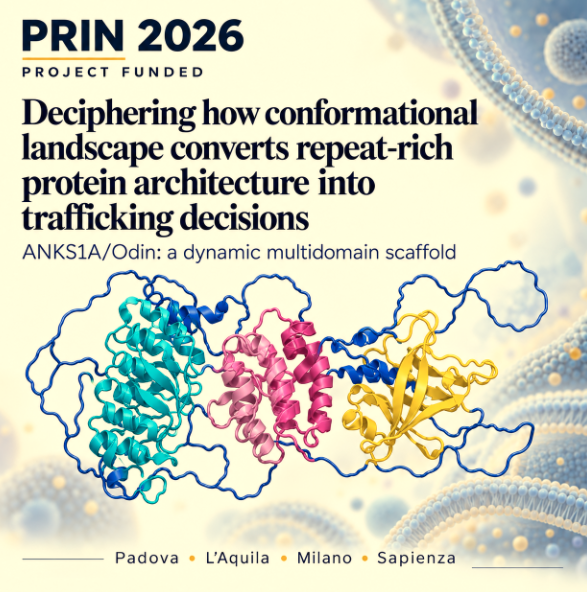
ANKS1A/Odin (~130 kDa) behaves as a dynamic conformational ensemble rather than a rigid structure. The project hypothesizes that its energy landscape encodes conformational states that regulate partner selection, assembly and receptor trafficking
Four interdependent work packages cover computational modelling of architecture and ensembles (University of Padua), folding kinetics and energetic coupling (Sapienza University of Rome), partner recognition and cellular validation (University of L’Aquila), and structural biology of domains, assemblies and complexes (University of Milan).
The expected outcome is the first structure–ensemble–function model of ANKS1A, with implications for signalling, cancer-relevant receptor trafficking and neurodegeneration-associated vascular clearance.